Cosmetic Removal of Skin Tags, Warts and Other Harmless Lesions
Cosmetic removal takes off a harmless skin growth for looks or comfort, not because it threatens your health.
Dr Ronak Patel, a private GP who trained in surgery first, assesses every lesion before treating it. He removes suitable skin tags, warts, moles and similar growths in Haywards Heath and Peacehaven under local anaesthetic.
The NHS rarely pays for this, and its skin tags guide classes removal of a harmless tag as cosmetic surgery that most adults pay for privately.
Every growth is assessed first at the Haywards Heath or Peacehaven clinic. If it shows features that need a closer look, Dr Patel advises further tests or a specialist referral, not cosmetic removal.
On this page
- 01What Is Cosmetic Removal?
- 02Signs a Lesion Needs a Check, and When to Get Help
- 03Conditions Dr Patel Treats with Cosmetic Removal
- 04Treatment Options for Cosmetic Removal
- 05Why Patients Choose Dr Patel for Cosmetic Removal
- 06Why Is Every Lesion Checked Before Removal?
- 07Alternatives to Cosmetic Removal
- 08Your Pathway, Step by Step: Appointment, Assessment and Removal
- 09Recovery and Risks After Cosmetic Removal
- 10Where Cosmetic Removal Takes Place
- 11Cosmetic Removal Fees and Insurance
- 12FAQs About Cosmetic Removal
- 13Book a Cosmetic Removal Assessment with Dr Ronak Patel
What Is Cosmetic Removal?
Cosmetic removal is treatment you choose for a lesion that is known to be benign, meaning not cancerous. The NHS page on cosmetic procedures and the NHS says such work is not routinely provided, so it is generally done privately.
Dr Patel picks from 3 methods: shaving the lesion flat, cutting it out and stitching the skin, or hyfrecation for small surface lesions. The type and site of the growth decide which of the 3 fits.
The table below shows how 4 common situations are usually handled.
| Situation | Usually treated as | Source |
|---|---|---|
| Harmless lesion removed purely for appearance | Cosmetic, paid privately | NHS |
| Lesion that is painful, bleeds or is irritated again and again | Possibly medically necessary | Dr Patel’s clinic |
| Mole that is changing, bleeding or looks suspicious | Medical: assessment and possible referral | Dr Patel’s clinic, NHS |
| Large, painful cyst that makes everyday tasks hard | May be removed on the NHS | NHS |
Signs a Lesion Needs a Check, and When to Get Help
Skin tags and warts are normally harmless, but some changes mean a doctor should look first. The NHS page on moles also lists a new mark that has not gone after a few weeks.
| Your symptom | Possible cause | What to do |
|---|---|---|
| Soft, skin-coloured flap on the neck, armpit or eyelid | Skin tag | Leave it, or book removal if it catches |
| Firm, rough lump on the hands, knees or fingers | Wart | Wait, try a pharmacy treatment or book an assessment |
| Firm nodule that dimples when pinched | Dermatofibroma (BAD) | Book an assessment if it bothers you |
| Skin tag that grows, bleeds or becomes painful | Needs a GP check | See a GP or book a skin check |
| Mole changing in size, shape or colour | Possible melanoma | See a GP promptly; it is not a cosmetic case |
| Fever, confusion or blotchy skin after a removal | Possible sepsis | Call 999 or go to A&E |
The NHS warts and verrucas page asks you to see a GP about a wart on the face or genitals, or one that bleeds or changes. A wound that turns hot, swollen and red after treatment needs the clinic, a GP or NHS 111 that day.
Conditions Dr Patel Treats with Cosmetic Removal
Skin tags: soft growths from about 2mm to 5cm, the NHS says, often in skin folds, on the neck or eyelids, or under the arms.
Benign moles: raised or unwanted moles, removed only after assessment, while changing moles follow the mole and skin lesion removal route.
Warts: common viral growths. Most go on their own, but this may take months or years.
Seborrhoeic keratoses: brown warty spots that affect 30% of people by age 40 and 75% by age 70, according to the BAD.
Dermatofibromas: firm, benign nodules, usually found on a leg. The BAD says razor shaving across one can make it bleed.
Haemangiomas: benign blood-vessel growths that can look red or purple.
Thread veins: small visible blood vessels near the surface, mostly on the face, where suitable for treatment.
Treatment Options for Cosmetic Removal
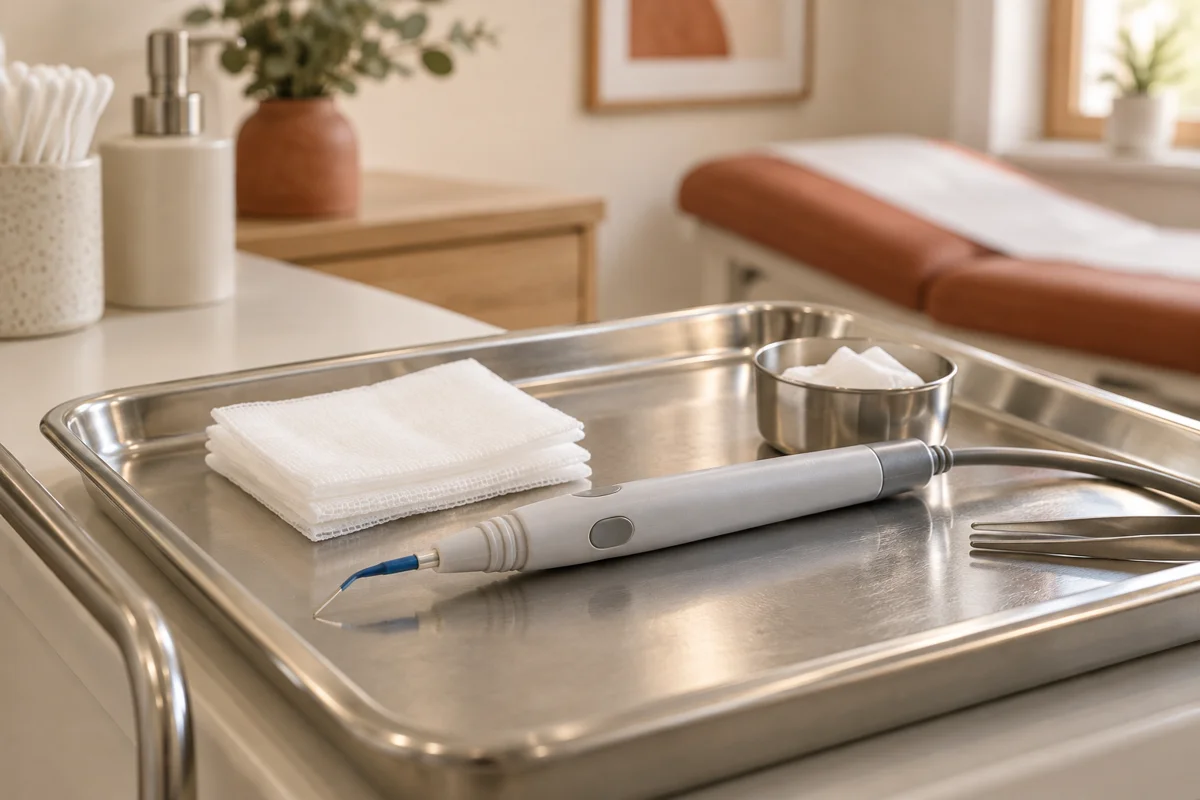
All 3 options take place in Haywards Heath or Peacehaven under local anaesthetic, and you leave with written aftercare. Dr Patel explains the method, likely mark and fee first.
Shave Excision
A blade slices a raised lesion level with the surrounding skin, and no stitches are needed. It suits skin tags, raised benign moles and seborrhoeic keratoses. It is a same-day treatment with no stay. Removing a skin tag can scar or darken the skin, especially black or brown skin. The change is usually temporary but sometimes lasting.
Hyfrecation for Surface Lesions
A fine electrical current heats and seals small surface lesions, and the NHS lists heat as one way to remove skin tags. It suits small tags and suitable surface spots, with no stay. Risks are a small scar and a lighter or darker patch, as the NHS describes for skin tags.
Excision with Stitches
Cutting the lesion out and stitching the skin suits deeper or firmer growths, such as dermatofibromas and some moles. Stitches are normally taken out 7 to 14 days later. The BAD warns that removing a dermatofibroma always leaves a scar, which may bother you as much as the lump did. The skin and minor surgery page describes this operation in full.
Why Patients Choose Dr Patel for Cosmetic Removal
- Checks before cosmetic work: each lesion is examined first, so a growth that needs investigation is never removed just for looks.
- Surgical grounding: membership of the Royal College of Surgeons (MRCS) followed his surgical training in 2006.
- Qualified at Guy’s and St Thomas’: a BSc (Hons) awarded in 1999, then his medical degree, MBBS, in 2002.
- Long general practice career: MRCGP in 2011 and 14 years in general practice, 13 of them as a partner in Brighton.
- Private since 2025: he left his NHS partnership early that year and now sees skin patients in Mid Sussex and Peacehaven.
Why Is Every Lesion Checked Before Removal?
The BAD says a very dark seborrhoeic keratosis can look like a melanoma. For that reason, the BAD wants any changing brown or black lesion checked by a GP or specialist.
The BAD dermatofibroma leaflet makes the same point about firm nodules, which can mimic worrying skin tumours. NICE guideline NG12 asks doctors to use a suspected cancer pathway referral when dermoscopy suggests a melanoma.
If a growth has features of concern, Dr Patel explains what he sees and arranges further tests or referral, as the histology and results page explains.
Please do not cut or tie off a lesion at home, because the NHS skin tags guide warns of infection, bleeding and scarring. Home removal also loses the chance of a proper diagnosis.
Alternatives to Cosmetic Removal
Doing nothing is a sound option, and skin tags do not need removing. Dr Patel can simply confirm what a lesion is.
For warts, pharmacy creams, plasters and sprays can take up to 3 months, the NHS says, and should not be used on the face. A GP may freeze a wart, though the NHS asks you to check whether this is funded in your area.
For dermatofibromas, the BAD lists steroid injections, freezing and some lasers, each with its own risk of a mark. Skin camouflage creams can also hide a mark you do not want treated, according to the NHS scars page.
Your Pathway, Step by Step: Appointment, Assessment and Removal
- 1Call or request online: phone 01444 620182 for Haywards Heath or 01273 907945 for Peacehaven, or use the web form.
- 2Assessment: at Haywards Heath or Peacehaven, Dr Patel looks at each lesion to confirm the likely diagnosis and the right treatment.
- 3Plan: the method, the mark it may leave, the risks and the fee are explained before you decide.
- 4Decision: you choose whether to go ahead, and a lesion with suspicious features is investigated or referred instead.
- 5Treatment: local anaesthetic, removal by shave, hyfrecation or excision, then home the same day.
- 6Aftercare: written advice, and a stitch check if stitches were used, at 7 to 14 days.
Recovery and Risks After Cosmetic Removal
Removal can scar or darken the skin, more often on black or brown skin, and this usually fades but sometimes stays.
Where stitches are used, they normally come out after 7 to 14 days. The same leaflet says to keep water off for the first few days and to dab, not rub, when drying.
Removal does not stop new growths forming: a removed skin tag does not usually return, but new ones can appear. The BAD says seborrhoeic keratoses can regrow at the same site.
| Treatment | Hospital stay | Example risk |
|---|---|---|
| Shave excision of a skin tag or mole | None, home the same day | Scarring or darker skin, usually temporary |
| Hyfrecation of a surface lesion | None, home the same day | Small scar or colour change |
| Excision with stitches | None, home the same day | Stitches out at 7 to 14 days |
| Dermatofibroma removal | None, home the same day | A scar that may bother you as much as the lump (BAD) |
| Seborrhoeic keratosis removal | None, home the same day | Can regrow at the same site (BAD) |
Where Cosmetic Removal Takes Place
Cosmetic removal is offered at 2 skin clinics, in Haywards Heath and Peacehaven. It is not performed at Spire’s Montefiore Hospital in Hove. Haywards Heath sessions run on Mondays, 2.00pm to 5.00pm, and Peacehaven sessions on Mondays, 9.00am to 1.00pm, so ring the clinic to book.
Location: Facial Aesthetics Centre
Address: 2 The Broadway, Haywards Heath RH16 3AH
Phone: 01444 620182
Session times
Haywards Heath: Monday 2.00pm–5.00pm · Peacehaven: Monday 9.00am–1.00pm
Check when you ring
Cosmetic Removal Fees and Insurance
Dr Patel sets out the price after assessing you. It depends on the type, size, site and number of lesions and on the method, and the fees page lists 2026 prices.
If you have private medical insurance, check your cover with your insurer before you book.
Cosmetic removal of harmless skin lesions is not usually covered by insurance.
A lesion that is painful, bleeds or keeps getting irritated may count as medically necessary. Ask about authorisation before you book.
FAQs About Cosmetic Removal
Can a mole be taken off just because I dislike it?
Yes, if it is benign and an assessment in Haywards Heath or Peacehaven confirms it. Dr Patel then explains the method, the likely mark and the cost before you decide.
When does mole removal count as medical rather than cosmetic?
When a mole is changing, bleeding or looks suspicious, as the NHS moles page describes. It then needs medical assessment, and further tests or a specialist referral may follow.
Will a skin tag come back once it is removed?
A removed skin tag does not usually return. New tags can still grow in the same area or elsewhere.
Why will the NHS not remove a harmless skin tag?
The NHS treats people by clinical need, and it classes harmless skin tag removal as cosmetic surgery. Some removals are funded when specific medical criteria are met.
How much does cosmetic removal cost?
It depends on how many lesions you have, their size and site, and the method used. The 2026 fees are on the fees page, and the total is explained before treatment.
Is cosmetic removal major surgery?
No. It uses local anaesthetic in a clinic room, and you go home the same day. A small wound and a mark are still expected.
How long does recovery take after a skin tag or wart is removed?
Where stitches are used, they come out after 7 to 14 days. Any darker skin usually fades.
Can I drive after having a lesion removed?
The NHS advises arranging a lift home after a local anaesthetic. Plan ahead if the lesion is on your hand or near your eye.
Can several lesions be removed at one visit?
Often, yes, for small skin tags and similar growths. Dr Patel confirms how many are suitable at your assessment.
What are the alternatives to having a wart cut out?
Waiting, pharmacy treatments for up to 3 months, or freezing by a GP, according to the NHS. Most warts clear without treatment in time.
Can I cut a skin tag off myself?
Please do not. The NHS warns of infection, bleeding and scarring, and an unchecked lesion could be something that needs a diagnosis.
Will removal leave a mark on darker skin?
It can. Darkening after skin tag removal is more common on black or brown skin and is usually temporary.
Related pages: cysts and lipomas, skin checks and scarring and recovery.
Book a Cosmetic Removal Assessment with Dr Ronak Patel
Arrange an assessment to confirm what your lesion is and whether removal suits it. You can ask about several lesions at the same visit.
- Facial Aesthetics Centre, Haywards Heath: 01444 620182
- Epsom Skin Clinic, Peacehaven: 01273 907945
- Online: the skin appointment request form or the contact form
At a glance
What is it?
Private removal of a harmless skin lesion for looks or comfort, after a check
Who is it for?
Adults with skin tags, warts, benign moles, dermatofibromas, haemangiomas, thread veins or similar
How long does it take?
One clinic visit; several small lesions can often be treated together
Hospital stay
None: local anaesthetic, then home the same day with aftercare advice
Recovery
Stitches, if used, out at 7 to 14 days; colour change usually temporary
Scarring and Recovery After Minor Skin Surgery
Related guide